Air Quality and Wildfire Smoke in Stouffville: Protecting Your Lungs and Heart
When wildfire smoke drifts over town, the AQHI tells you when to ease off. Who is at risk, how to clean indoor air and when Stouffville residents need care.
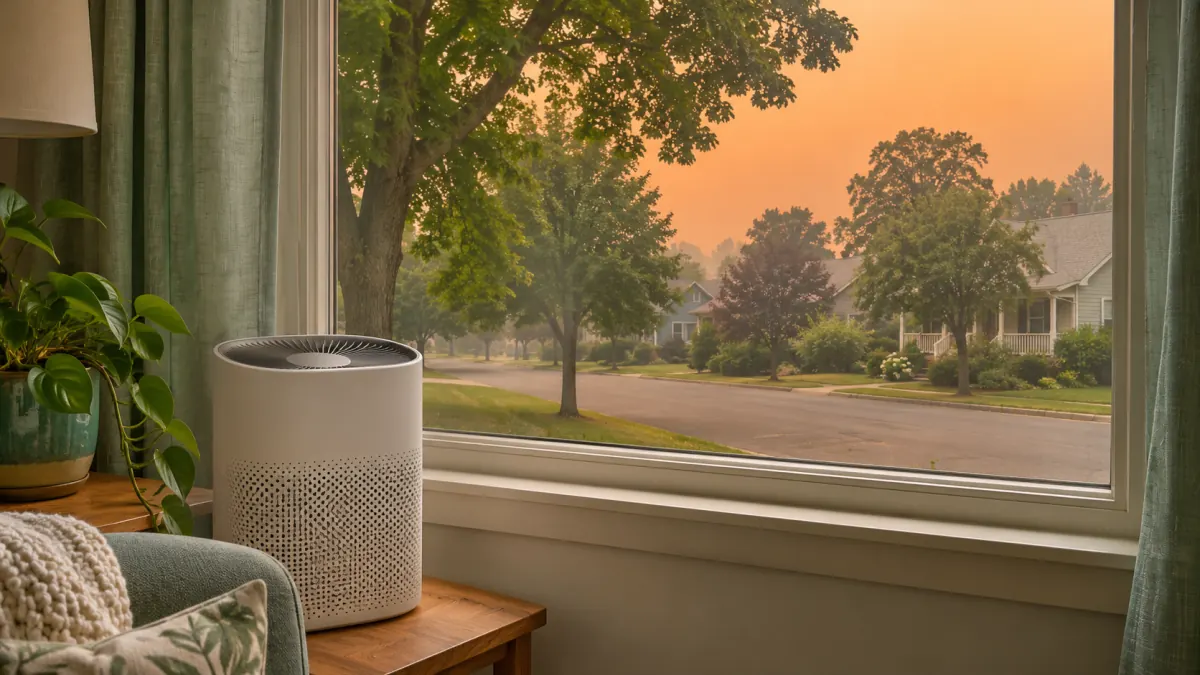
The sky over Main Street turned the colour of weak tea, the sun hung there as a flat orange disc, and the whole town smelled faintly like a campfire nobody had lit. Fires burning hundreds or even thousands of kilometres away in northern Ontario, Quebec or western Canada can do that. Smoke rides the upper winds for days and settles over southern Ontario with very little warning, and Whitchurch-Stouffville has had its share of those hazy afternoons in recent summers.
Most healthy people feel little more than scratchy eyes and a mild cough on a smoky day. But wildfire smoke is not just an unpleasant smell. It carries fine particles small enough to travel deep into the lungs and into the bloodstream, and for people with asthma, COPD, heart disease, pregnancy, young children and older adults, those particles can trigger real health problems. Knowing how to read the warnings and set up your home ahead of time makes a measurable difference.
What is actually in wildfire smoke
Wildfire smoke is a mixture of gases and tiny particles from burning trees, brush and sometimes buildings. The component health experts worry about most is fine particulate matter, known as PM2.5: particles 2.5 micrometres across or smaller, roughly one-thirtieth the width of a human hair. These particles:
- Bypass the nose and throat’s usual filters and reach the small airways
- Irritate and inflame the lining of the lungs
- Can enter the bloodstream and affect blood vessels and the heart
- Linger indoors if windows are open or ventilation pulls in outdoor air
Because the particles are so small, the smell of smoke is an unreliable guide. Air can be unhealthy even when it doesn’t smell strongly of smoke, and some smoky-smelling days carry relatively few particles.
Reading the AQHI
The Air Quality Health Index (AQHI) is Canada’s public scale for air pollution and health. It runs from 1 upward, with readings above 10 shown as “10+.” You can check the current reading and forecast for the York Region area through Environment and Climate Change Canada’s weather website or the WeatherCAN app, and special air quality statements are issued when wildfire smoke is expected.
| AQHI | Risk level | People at higher risk | General population |
|---|---|---|---|
| 1 to 3 | Low | Enjoy usual outdoor activities | Ideal air quality for outdoor activities |
| 4 to 6 | Moderate | Consider reducing or rescheduling strenuous outdoor activity if you have symptoms | No need to change usual activities unless you have symptoms |
| 7 to 10 | High | Reduce or reschedule strenuous activities outdoors; children and older adults should also take it easy | Consider reducing strenuous outdoor activity if you have symptoms such as coughing or throat irritation |
| Above 10 | Very high | Avoid strenuous activities outdoors | Reduce or reschedule strenuous outdoor activities, especially if you have symptoms |
A useful habit during smoke season is to glance at the AQHI the same way you check the temperature before deciding whether to run the Stouffville Reservoir loop, send kids to an outdoor day camp or mow the lawn.
Who needs to be most careful
Some groups are more sensitive to smoke than others:
- People with asthma or COPD. Smoke can trigger flare-ups that develop over hours to a day or two. See our asthma management and COPD management pages for the ongoing care side of things.
- People with heart disease. Fine particles are linked to angina, heart rhythm problems, heart attacks and strokes in people already at risk. If you have a heart condition, keep your nitroglycerin spray or other prescribed rescue medication within reach on smoky days.
- Pregnant people. Limiting exposure is sensible, since smoke exposure has been associated with pregnancy complications.
- Infants and children. They breathe faster than adults relative to their size and spend more time active outdoors.
- Older adults, especially those with chronic conditions.
- People with diabetes, which affects blood vessels and increases cardiovascular risk.
- Outdoor workers, from landscapers and roofers to farm workers on the fields around Bloomington and Lincolnville, who may have long exposures.
A smoke-day plan for your household
Preparing before the haze arrives is easier than scrambling during it. Here is a practical plan.
- Check your medications. If you use an inhaler, make sure you have enough of both your reliever and controller, and that they haven’t expired. If you have an asthma or COPD action plan, review it.
- Pick a “clean air room.” Choose one room, ideally a bedroom, where you can keep the air as clean as possible. Keep windows and doors in that room closed during smoky periods.
- Use a portable air cleaner. A HEPA air cleaner that is properly sized for the room’s square footage can substantially reduce indoor particles. Avoid devices that produce ozone, such as ionizers or “ozone generators.”
- Upgrade your furnace filter. If your home has central heating or air conditioning, a higher-efficiency filter (often MERV 13, if your system can accommodate it) helps. Running the fan on recirculate keeps air moving through the filter. Ask an HVAC technician if you are unsure what your system supports.
- Keep indoor sources down. Skip frying, candles, incense, wood stoves and vacuuming without a HEPA filter on smoky days; all of these add particles indoors.
- Plan for heat. Closing windows during a heat wave can make homes dangerously hot. If your home overheats, your health risk from heat may be greater than from smoke. A cooled public space, such as the Whitchurch-Stouffville Leisure Centre or a library, can be a good option. Our post on heat exhaustion and heat stroke explains the warning signs.
- Move activities indoors or reschedule them. This is especially true for children’s sports, long runs and strenuous yard work.
Do masks help?
A well-fitted N95 or equivalent respirator can reduce the amount of fine particles you inhale outdoors. Fit matters: gaps around the nose and cheeks let smoky air in. Cloth masks and loose surgical masks offer much less protection against fine particles. Respirators can make breathing harder for some people with lung or heart conditions, and they are not designed for young children, so the best protection for kids is reducing time outdoors on high-AQHI days. Beards also prevent a good seal.
Cars and commutes
A car’s ventilation set to recirculate, with windows closed, reduces smoke exposure during short drives. Cabin air filters vary in how well they capture fine particles, so don’t assume a car is a clean air space for long periods.
Symptoms and when to get help
Common, mild symptoms on smoky days include:
- Sore or scratchy throat
- Watery, stinging eyes
- Runny nose and sinus irritation
- Mild cough
- Headache
These usually ease when air quality improves or when you spend time in cleaner indoor air. Saline nose rinses, lubricating eye drops and plenty of fluids can help with comfort.
More concerning symptoms deserve medical attention, particularly in people with asthma, COPD or heart disease:
- Increasing shortness of breath or wheezing
- Needing your reliever inhaler more often than usual
- A cough that keeps worsening
- Unusual fatigue, dizziness or palpitations
If you are managing asthma, our post on keeping asthma under control explains how to recognize when an action plan needs to step up. For worsening symptoms that aren’t an emergency, an in-person visit or virtual care appointment may allow your clinician to adjust treatment without you having to spend time outdoors.
Call 911 for these
Call 911 or go to the nearest emergency department, such as Markham Stouffville Hospital or Uxbridge Hospital, if you or someone with you has:
- Severe difficulty breathing, or cannot speak in full sentences
- Chest pain, pressure or tightness
- Lips or fingertips turning blue or grey
- Sudden weakness, numbness, facial drooping or trouble speaking
- Confusion or fainting
- A reliever inhaler that is not helping
Don’t drive yourself if you have chest pain or severe breathlessness.
After the haze lifts
Once the AQHI drops back into the low range, open windows to air out the house, and consider replacing or cleaning filters that worked hard during the smoky stretch. A HEPA filter that has run constantly for several days may be due for a change sooner than the box suggests.
It is also worth paying attention to how you felt. If a single smoky week in Stouffville left you wheezing, using your reliever every day, or more short of breath than usual on the stairs, that is useful information. It may mean your asthma or COPD is not as well controlled as it could be, even on clear days, and a review with your clinician could help you go into the next smoke season in better shape. Lingering cough or chest symptoms that persist more than a week or two after the air clears should also be checked.
Should my kids skip outdoor soccer when it's smoky?
Does a regular air conditioner filter the smoke?
Before the next hazy week
The best time to plan for smoke is on a clear day. If you or someone you care for in Stouffville has a lung or heart condition, consider booking a visit to review medications, inhaler technique and your action plan before summer smoke season arrives. You can schedule an appointment online, or reach our team with questions about whether an in-person or virtual visit makes more sense. Our hours can change, so please check the location page before you come by.
Please treat this article as general guidance; it does not replace advice tailored to your own health by your clinician.