Ear Wax Removal in Stouffville: Safe Options and What to Avoid
Muffled hearing or a plugged ear? Here's how ear wax builds up, which home remedies are safe, what to skip, and when a Stouffville clinic visit makes sense.
Quick check: does one ear feel full or plugged, as though you’ve just stepped off a plane? Have conversations started sounding muffled on one side, or are you turning the TV up more than usual? Do you hear a faint ringing, or does your hearing aid keep whistling? Have you been reaching for cotton swabs more often lately?
If you answered yes to a couple of these, ear wax could be the culprit. It’s one of the most common reasons people in Stouffville and across York Region visit a family doctor or walk-in clinic, and it’s also one of the most satisfying problems to fix. But there’s a right way and a wrong way to go about it, and some popular home methods can do real harm. Here’s what Stouffville patients should know before reaching for anything sharper than a washcloth.
Ear wax isn’t dirt
The proper name for ear wax is cerumen, and your body makes it on purpose. Glands in the outer part of the ear canal produce a mix of oils and secretions that combine with dead skin cells and trapped dust. The result is a substance that:
- Keeps the skin of the ear canal moisturized and stops it from cracking
- Traps dust, debris and small insects before they reach the eardrum
- Has mild antibacterial and antifungal properties
- Moves itself out of the ear naturally as you chew and talk
That last point matters. The skin of the ear canal grows outward, a little like a slow conveyor belt, carrying old wax toward the opening where it dries and falls away without you noticing. For most people, most of the time, ears clean themselves. The only cleaning they need is a wipe of the outer ear with a cloth in the shower.
Why wax builds up for some people
Some people simply make more wax, or wax that’s drier and harder, and are prone to blockages no matter what they do. Other factors that make build-up more likely include:
- Cotton swabs. They tend to push wax deeper and pack it against the eardrum, where it can’t escape naturally.
- Hearing aids and earbuds. Anything that sits in the canal for long periods can block wax from moving out and stimulate more production.
- Narrow or curved ear canals, which some people are born with.
- Ageing. Wax often becomes drier and harder in older adults.
- Hairy ear canals, which can trap wax.
- Certain skin conditions such as eczema affecting the ears.
If you wear hearing aids, it’s worth having your ears checked regularly by your Stouffville family doctor or clinic, since even a moderate amount of wax can affect how well the devices work.
What to avoid
This is the section most worth reading twice. The ear canal is lined with thin, sensitive skin, and the eardrum at the end of it is delicate. Many common habits put both at risk.
Cotton swabs and other objects
It’s tempting to “just get a bit out” with a swab, a bobby pin, a key, or the corner of a towel. Doctors regularly see scratches, infections and occasionally perforated eardrums from these attempts. Swabs also tend to make blockages worse. The old advice holds: don’t put anything smaller than your elbow in your ear.
Ear candling
Ear candling involves placing a hollow, cone-shaped candle in the ear and lighting the far end, supposedly to draw wax out. It doesn’t work — the residue inside the candle afterwards is candle wax, not ear wax — and it can cause burns to the face, ear canal and eardrum, and drip candle wax into the ear. Health Canada has warned against ear candles. Please skip them.
Online “ear cleaning” gadgets
Camera-equipped picks, spiral scrapers and high-pressure irrigation bottles are widely sold. Some may seem helpful, but without training and a good view, it’s easy to scratch the canal or push wax deeper. High-pressure jets in particular can injure the eardrum.
Irrigating at home when you shouldn’t
Rinsing the ear with water is not safe for everyone. Don’t irrigate your ears, at home or anywhere else, without a doctor’s advice if you:
- Have, or might have, a hole in your eardrum
- Have ear tubes (grommets) or have had ear surgery
- Have an ear infection, ear pain, or discharge from the ear
- Have diabetes or a weakened immune system, which raises the risk of a serious outer ear infection
- Have had problems with irrigation before
Safe home care for mild build-up
If you have mild symptoms, no pain, no discharge, no history of eardrum problems, and normal hearing in the other ear, it’s often reasonable to try softening the wax first. A typical approach looks like this:
- Choose a softener. Plain mineral oil, olive oil, or an over-the-counter wax-softening drop from a pharmacy (often containing carbamide peroxide) are common options. Your pharmacist can help you pick one.
- Warm the bottle in your hand for a minute so the drops are close to body temperature. Cold drops can cause brief dizziness.
- Lie on your side with the affected ear facing up.
- Put in a few drops as directed on the package, and stay lying down for five to ten minutes so the drops can work in.
- Sit up with a tissue against the ear to catch any drainage. Don’t dig.
- Repeat once or twice a day for three to five days, or as the product directs.
Many blockages loosen and clear on their own with this approach. If symptoms aren’t better after about a week, or they get worse, it’s time to have your ear looked at. Stop the drops and see a doctor if you develop pain, discharge, dizziness, or a rash.
What happens at the clinic
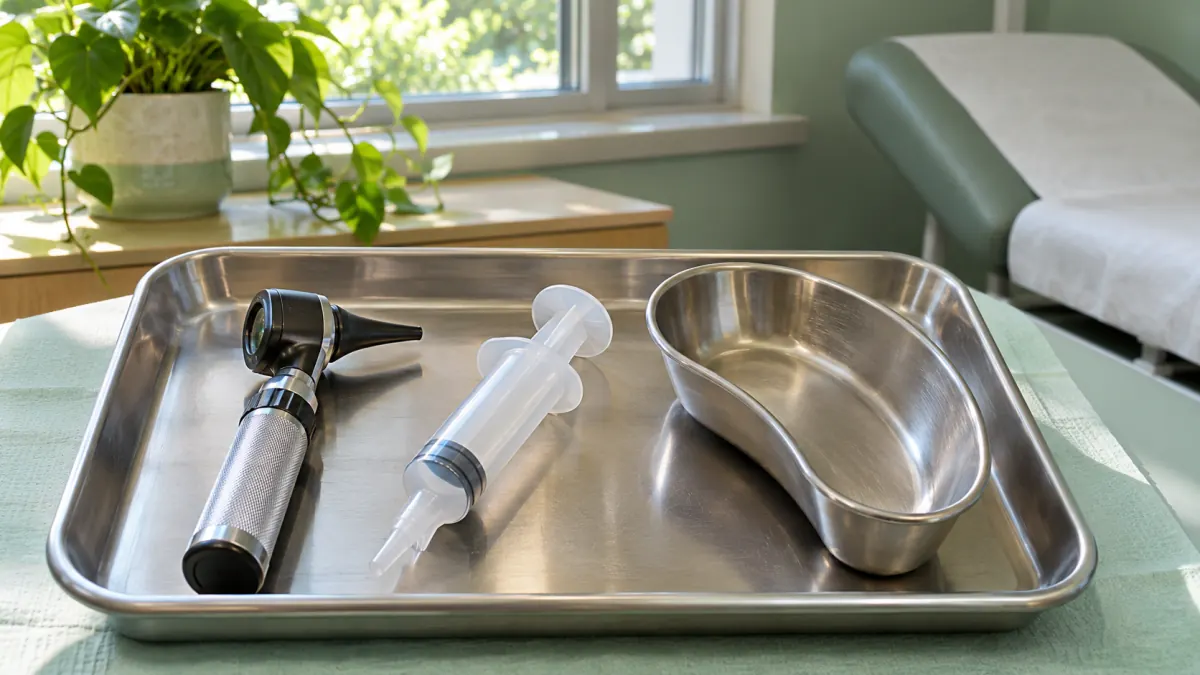
When you come in for ear wax concerns, the first step is a look with an otoscope, the small lighted instrument doctors use to see the ear canal and eardrum. This tells us whether wax is actually the problem — sometimes the cause of a plugged feeling turns out to be fluid behind the eardrum from a cold, an infection, or something else entirely.
If wax is blocking the canal, the main removal options are:
| Method | How it works | Good to know |
|---|---|---|
| Irrigation (syringing) | Lukewarm water is gently flushed into the ear canal to wash the softened wax out | Usually works best after a few days of softening drops; not suitable if the eardrum may be perforated |
| Manual removal | A doctor uses small instruments, such as a curette or loop, under direct view to lift wax out | Useful for wax near the opening or when irrigation isn’t appropriate |
| Microsuction | A small suction device removes wax under magnification | Often offered by ear, nose and throat specialists or some hearing clinics |
At HealthSmart, ear wax removal is one of the minor procedures we offer. The doctor will recommend the approach that suits your ear and your history. You may be asked to use softening drops for several days beforehand, because hard wax that hasn’t been softened is more difficult and uncomfortable to remove.
Most people feel the difference immediately — sounds suddenly seem bright and sharp. It’s normal to feel a little light-headed or have a brief tickle in the throat during irrigation; let the doctor know and they’ll pause.
After removal
Your ear may feel slightly sensitive for a day. Keep it dry if advised, and avoid putting anything in it. If you’re prone to build-up, your doctor may suggest using a few drops of oil once a week or so to keep wax soft, or periodic checks.
When it isn’t wax
Not every blocked ear is a wax problem. These symptoms point toward something else and deserve an assessment rather than home treatment:
- Ear pain, especially with fever, which can suggest an ear infection. Our clinic also offers ear infection treatment.
- Discharge of pus or blood from the ear.
- Itching and pain after swimming, which may be swimmer’s ear (an outer ear infection) — common in summer among Stouffville swimmers, whether at the Whitchurch-Stouffville Leisure Centre pool or in local lakes.
- Dizziness or spinning, with or without hearing changes.
- Ringing in one ear only that persists.
Seek urgent care for these
- Sudden hearing loss in one ear, without an obvious blocked feeling from wax or a cold, needs prompt same-day medical assessment, as early treatment can matter.
- Severe ear pain with high fever, swelling or redness behind the ear, or the ear sticking out.
- Ear injury from a blow to the head, a blast, or an object pushed into the ear, especially with bleeding, hearing loss or dizziness.
- Facial weakness, severe headache, or confusion along with ear symptoms — call 911 or go to the nearest emergency department, such as Markham Stouffville Hospital or Uxbridge Hospital.
Can children have ear wax removed?
How often should I have my ears cleaned?
Is ear wax removal covered by OHIP?
Clearer hearing, close to home
If your ears are feeling plugged in Stouffville, there’s no need to wait it out or risk a home gadget. Start softening drops if they’re right for you, then book an appointment at HealthSmart Medical Clinic if things don’t improve. Our clinic is at 208-5892 Main Street, and you can find directions and current hours on our location page. For a same-day problem, our walk-in clinic may also be able to help.
Please treat this article as general information only — a physician who has examined your ears can give advice specific to you.