ECG Testing in Stouffville: What It Shows and How It Works
An ECG records your heart's electrical activity in a few painless minutes. Here is what the test can and cannot show, and how to prepare for one in Stouffville.
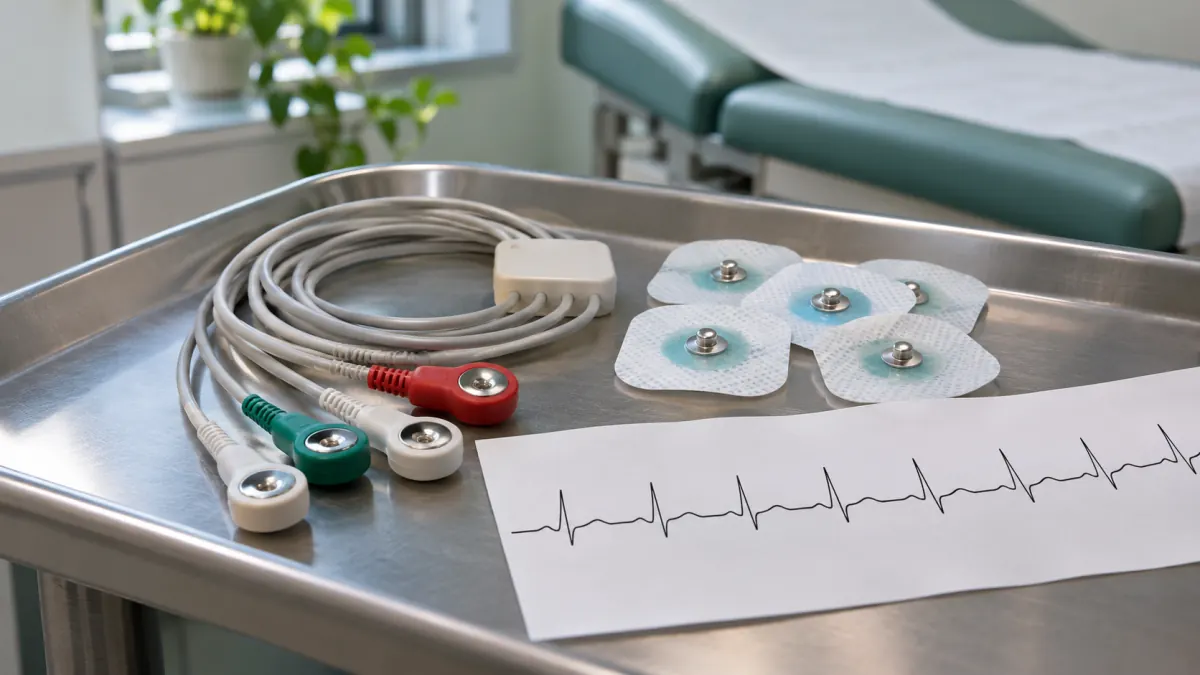
There is a common belief that an ECG is a “heart attack test,” something you only have in an ambulance or a hospital emergency room. In reality, the electrocardiogram is one of the most routine tests in medicine. It is quick, painless and non-invasive, and family physicians order it for all kinds of reasons: a fluttering heartbeat, a pre-operative checkup, a medication review, or simply a baseline reading for someone with risk factors. If your clinician has suggested one, or you are curious about what that wavy line on the printout actually means, this explainer is for you.
What an ECG measures
Every heartbeat begins with a tiny electrical signal. It starts in a natural pacemaker in the upper right chamber of the heart, spreads across the upper chambers (the atria), pauses briefly at a relay point, and then travels through the lower chambers (the ventricles), which contract to pump blood to the body. An ECG, sometimes written EKG, picks up that electrical activity through sticky sensors placed on the skin and records it as a series of waves.
A standard resting ECG uses 12 “leads,” which are different electrical viewpoints of the heart created from 10 electrodes on the chest, arms and legs. Looking at the heart from 12 angles lets a clinician spot patterns that one view alone might miss.
Reading the waves, in plain language
You do not need to interpret your own ECG, but knowing the basic parts can make the conversation with your clinician easier.
| Part of the trace | What it represents |
|---|---|
| P wave | The electrical signal spreading through the upper chambers |
| PR interval | The time the signal takes to travel from the upper to the lower chambers |
| QRS complex | The signal spreading through the lower chambers as they contract |
| ST segment | A short flat stretch between contraction and recovery; changes here can point to reduced blood flow |
| T wave | The lower chambers recovering electrically before the next beat |
| QT interval | The total time for the lower chambers to contract and recover; some medications can lengthen it |
Why your clinician might order one
An ECG can be useful in many situations. Some of the most common:
- Palpitations: a racing, pounding, skipping or fluttering heartbeat.
- Dizziness or fainting, especially if it happens without an obvious cause.
- Shortness of breath or reduced exercise tolerance that needs investigation.
- High blood pressure, to look for signs that the heart muscle has thickened over time.
- Diabetes, high cholesterol or a strong family history of heart disease, as part of a broader risk assessment.
- Before surgery or certain procedures, depending on your age and health.
- Medication monitoring, since some medicines can affect heart rhythm or the QT interval.
- Medical exams for some jobs or activities, where a baseline is requested.
Sometimes the reason is very ordinary. A Stouffville GO commuter notices their heart thumping after a sprint for the train and wonders whether that is normal. A grandparent in Ballantrae starts a new medication and their prescriber wants to check its effect on the heart’s rhythm. A recreational hockey player in their fifties wants reassurance before a new season. None of these situations is an emergency, but each is a reasonable time to ask whether an ECG would add useful information.
At HealthSmart, ECG testing is part of a wider approach to heart health monitoring, which may also include blood pressure checks, blood work and lifestyle review.
What an ECG can and cannot show
What it can pick up
- Heart rate and rhythm, including irregular rhythms such as atrial fibrillation.
- Conduction problems, where the electrical signal is delayed or blocked along its path.
- Signs of a previous heart attack, sometimes even one that went unnoticed.
- Signs of strain or thickening of the heart muscle.
- Changes linked to electrolyte imbalances, such as high or low potassium.
- Effects of certain medications on the heart’s electrical activity.
What it cannot do on its own
A resting ECG is a snapshot of about ten seconds of heart activity while you lie still. That has limits:
- An irregular rhythm that comes and goes may not show up during those few seconds.
- A normal resting ECG does not rule out blocked arteries. Coronary artery disease often only shows on an ECG during exercise or during an actual episode of reduced blood flow.
- It does not show the structure of the heart valves or how well the heart pumps in detail. That usually requires an echocardiogram (an ultrasound of the heart).
This is why your clinician will interpret an ECG alongside your symptoms, examination and other results, and may recommend further tests if something is unclear.
Other heart rhythm tests you may hear about
If a resting ECG is normal but symptoms continue, or if more detail is needed, your clinician may arrange one of these through diagnostic referral services:
- Holter monitor: a small portable recorder worn for 24 to 48 hours, sometimes longer, to capture rhythm changes over a full day and night.
- Event or patch monitor: worn for days to weeks, useful when symptoms are infrequent.
- Exercise stress test: an ECG recorded while you walk on a treadmill, to see how the heart responds to effort.
- Echocardiogram: an ultrasound that shows the heart’s chambers, valves and pumping strength.
These are typically done at hospital departments or community diagnostic centres, and for Stouffville residents that may mean a short drive to Markham or another nearby community. Your clinician will explain which, if any, is appropriate and where it can be done.
How the test works, step by step
For most people the entire appointment takes only a few minutes, and the recording itself takes less than a minute.
- Getting ready. You will be asked to remove clothing from the waist up and change into a gown, and to uncover your lower legs or ankles. Wearing a two-piece outfit makes this easier.
- Placing the electrodes. Small adhesive stickers are placed on your chest, wrists or upper arms, and ankles or lower legs. If there is chest hair in the way, a small area may need to be trimmed so the stickers stay put.
- Lying still. You lie flat and relaxed. Talking, shivering or tensing muscles can create “noise” on the trace, so you will be asked to stay quiet and breathe normally.
- Recording. The machine records the signals. You feel nothing. No electricity goes into your body; the sensors only listen.
- Finishing up. The stickers are peeled off, which can feel a little like removing a bandage, and you can get dressed.
Tips to make it go smoothly
- Avoid applying body lotion, oil or powder to your chest and limbs on the day of the test; they can stop the electrodes from sticking.
- Let the staff know if you have a pacemaker or implanted defibrillator.
- Bring an up-to-date list of medications.
- Mention any symptoms you have had recently, including when they happened and how long they lasted.
- If you feel cold, say so. Shivering is a common cause of a fuzzy recording, and a blanket can help.
Getting your results
A clinician reviews the ECG tracing. Computer-generated interpretations are printed on many machines, but they are a starting point only and can be wrong in both directions. A human review in the context of your health history is what counts. Your clinician will let you know how results are shared and whether a follow-up appointment is needed. If something needs urgent attention, the clinic will contact you.
An “abnormal” finding does not always mean a problem. Some variations are normal for an individual, more common in athletes, or related to body shape and electrode placement. Your clinician may compare with any previous ECGs or simply repeat the test.
Heart symptoms that should not wait for a test
An ECG appointment at a clinic is for symptoms that are stable or for planned checks. Some symptoms need emergency care right away. Call 911 if you have:
- Chest pain, pressure, squeezing or heaviness, especially if it spreads to the arm, neck, jaw or back
- Chest discomfort with sweating, nausea or shortness of breath
- Fainting or nearly fainting, particularly during exertion
- A very fast or irregular heartbeat with dizziness, breathlessness or chest pain
- Sudden weakness, numbness, facial drooping, confusion or trouble speaking, which can be signs of stroke
Do not drive yourself. Paramedics can begin assessment and treatment, including an ECG, before you reach the hospital. In the Stouffville area, the closest emergency departments are at Markham Stouffville Hospital and Uxbridge Hospital.
Quick answers
Does an ECG hurt or involve any risk?
Do I need to fast or stop my medications before an ECG?
Can a smartwatch replace an ECG?
Arranging an ECG in Stouffville
If you have had palpitations, a new heart-related concern, or your clinician has recommended a baseline tracing, our clinic in Stouffville can assess whether an ECG makes sense for you. Start by booking an appointment, or contact us with questions about what to bring. Our hours can change, so it is a good idea to check the location page before coming in.
Please treat this article as general information; it does not replace an assessment by a qualified health professional.