Head Lice in Stouffville: A Calm, Step-by-Step Plan for Parents
Head lice spread by head-to-head contact, not dirty hair. How Stouffville parents can confirm lice, choose a treatment, comb out nits and avoid repeat rounds.
The email from the school arrives just before dinner. A case of head lice has been reported in your child’s class, and families are asked to check their children’s hair. Within about four seconds, everyone in the house has started scratching, and someone has suggested burning the couch.
Take a breath. Head lice are a nuisance, not a health hazard. They do not carry disease, they are not a sign of a dirty home or poor parenting, and with a methodical approach they can be cleared up in a couple of weeks without throwing out the bedding or keeping kids home. Lice are common among children everywhere, Stouffville included, and they tend to show up in waves after school starts, after the holiday break, and after sleepovers and camps. This guide covers how to check, how to treat properly the first time, and when it is worth involving a doctor.
Getting to know the insect
Head lice are tiny wingless insects, about the size of a sesame seed when fully grown, that live on the human scalp and feed on small amounts of blood. Knowing a few facts about them takes much of the panic out of the situation.
- They crawl; they cannot jump or fly. Lice move from one head to another through direct head-to-head contact: hugging, leaning together over a tablet, sharing a pillow at a sleepover, piling together for a team photo.
- Sharing items plays a minor role. Hats, brushes, helmets and hair accessories can occasionally carry a louse, but this is far less common than direct contact.
- They do not survive long off the head. A louse that falls off usually dies within a day or two because it cannot feed.
- Pets are not involved. Head lice live only on humans. The dog and cat do not need treatment.
- Clean hair is no defence. Lice are perfectly happy on freshly washed hair. Hygiene has nothing to do with who gets them.
The life cycle, briefly
A female louse lays eggs, called nits, glued firmly to hair shafts very close to the scalp. They hatch in about a week. The young lice (nymphs) take roughly another week to mature and start laying their own eggs. That timeline is the reason almost every treatment plan includes a second round about a week after the first: you need to catch any lice that hatch from eggs that survived the initial treatment.
How to tell if your child has lice
Itching is the classic symptom, especially behind the ears and at the nape of the neck. It is caused by a reaction to louse saliva, which means that with a first infestation, itching may not start for several weeks. Some children never itch at all. Others scratch for reasons that have nothing to do with lice, such as dry winter skin or dandruff.
The only way to know for sure is to find a live louse. Nits alone do not prove an active infestation, because empty egg cases can stay glued to the hair for months after the lice are gone.
Wet combing: the most reliable check
Looking through dry hair with a flashlight misses many cases. Lice move quickly and avoid light. Wet combing is much more accurate.
- Wash the hair and apply plenty of ordinary conditioner. Do not rinse. The conditioner makes the hair slippery and slows the lice down.
- Detangle with a regular wide-tooth comb.
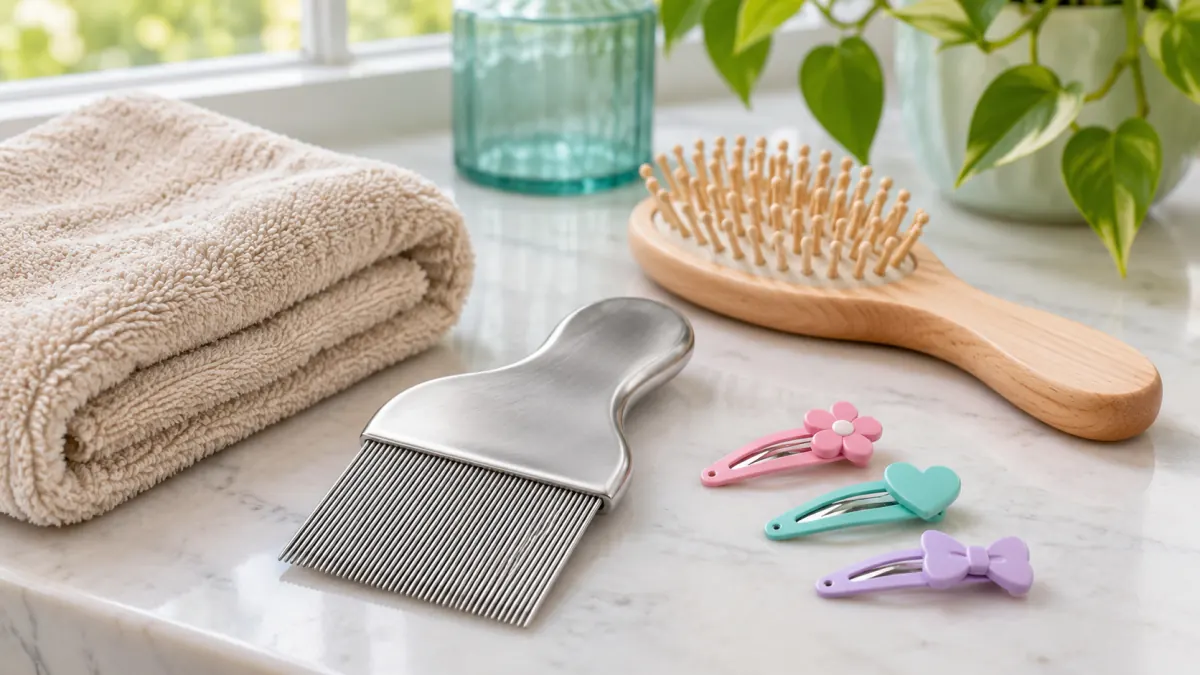
- Switch to a fine-toothed lice comb (metal combs with long teeth tend to work best).
- Starting at the scalp, draw the comb through a small section of hair all the way to the tips.
- After every stroke, wipe the comb on a white paper towel and look for lice.
- Work methodically around the whole head, section by section. This takes 10 to 30 minutes, depending on hair length and thickness.
- Rinse out the conditioner and clean the comb in hot soapy water.
A good light, a patient child and a favourite show help a lot.
Nits versus dandruff
Nits are small, oval and yellowish-white or tan. They are cemented to one side of a hair shaft and do not move when you blow on them or flick them. Dandruff, hair spray residue and dry skin flakes slide off easily. Nits found within about a centimetre of the scalp are more likely to be live eggs; those further out are usually empty shells.
Treatment options
If you find a live louse, treat that person. Most families in Stouffville and across Ontario can manage lice with products available at a pharmacy without a prescription. A pharmacist is a helpful first stop for choosing one.
| Type of product | How it works | Practical notes |
|---|---|---|
| Insecticide-based (permethrin, pyrethrins) | Acts on the louse’s nervous system | Long-standing options; some lice in North America have developed resistance |
| Physical or “coating” products (dimeticone, isopropyl myristate) | Coat or dissolve the louse’s outer layer so it cannot function | Not affected by insecticide resistance; follow timing carefully |
| Wet combing alone | Physically removes lice and nymphs | No chemicals; takes patience and must be repeated every few days for about two weeks |
| Prescription treatments | Various mechanisms | Considered when over-the-counter options have failed despite correct use |
Whatever you choose, these rules apply:
- Read and follow the instructions exactly, including how much to use, whether to apply to dry or wet hair, and how long to leave it on. Under-dosing and rinsing early are common reasons treatment fails.
- Repeat the treatment after 7 to 10 days, or as the product directs, to catch newly hatched lice.
- Comb afterward. Wet combing every two to three days for about two weeks after treatment removes stragglers and helps you confirm success.
- Check with a pharmacist or doctor first for babies and toddlers under two, during pregnancy or breastfeeding, and for anyone with scalp conditions, open sores or asthma that can be triggered by fragrances.
Things to skip
Gasoline, kerosene, pet flea and tick products, and other harsh chemicals are dangerous and should never be used on a child’s head. Mayonnaise, olive oil and essential oils are popular online, but there is little reliable evidence that they work, and some essential oils can irritate the skin. Shaving a child’s head is unnecessary and can be upsetting. And there is no need to use lice products “just in case” on family members who do not have live lice.
Around the house: less than you think
Because lice cannot survive long away from a scalp, deep cleaning is not required. A sensible, limited approach:
- Wash pillowcases, sheets, towels and recently worn hats in hot water and dry them on a hot setting.
- Soak brushes, combs and hair accessories in hot water for 10 minutes, or simply set them aside for a couple of days.
- Items that cannot be washed, like a stuffed animal that has been on the pillow, can be placed in a sealed bag for a few days or run through a hot dryer.
- Vacuum the couch and car seats if you like, but there is no need for sprays or fumigation.
Check everyone in the household using wet combing, and treat only those with live lice. If one child has lice, siblings and parents who share close contact are worth checking on the same day and again a week later.
School, daycare and those “no-nit” policies
Policies for head lice vary from one school board and daycare to the next, and Stouffville families may find that the rules at a child’s elementary school differ from those at a younger sibling’s daycare. Some schools ask parents to keep children home until all nits are gone, often called a “no-nit” policy. Many others allow children to return after the first treatment, or do not exclude children at all.
Children’s health organizations in Canada generally point out that by the time lice are found, a child has usually had them for weeks, so keeping them home does little to prevent spread and costs kids valuable learning time. Still, it is the school’s policy that applies, so check with your child’s school or daycare about what they require. A quick, discreet heads-up to the parents of close friends or recent sleepover guests is a kind thing to do, because they can then check their own children and help stop the round-robin that keeps lice circulating through a class.
If lice notices seem to arrive every September, our back-to-school health checklist includes a few other habits that make the first weeks of the year go more smoothly.
Why lice come back, and what to do about it
Ask any Stouffville parent who has been through it: few things are more discouraging than finding live lice a week after you thought you were done. When that happens, it is usually one of these:
- The second treatment was skipped or done too early, so eggs hatched and matured.
- The product was not used correctly, for example on hair that was too wet, or rinsed out early.
- The lice are resistant to an insecticide-based product.
- Reinfestation from a friend, sibling or classmate who has not been treated.
If you have done two careful rounds and still find live lice, switch to a product with a different mechanism (for example, from an insecticide to a coating product), recheck everyone in close contact, and consider asking a doctor for advice.
When to see a doctor
Most cases of head lice never need a medical visit. Do book an appointment if:
- The scalp looks infected: increasing redness, swelling, oozing, crusting or pain, especially with swollen glands in the neck
- Your child has scratched the skin raw, or has eczema on the scalp that is flaring
- You see lice or nits in the eyelashes or eyebrows, which need a different treatment
- Over-the-counter treatments have failed despite being used correctly twice
- The child is under two, or has a medical condition that makes you unsure which product is safe
- You are not sure whether what you are seeing is lice at all
For a quick question about which product is suitable or whether a rash looks infected, virtual care with a photo can be a convenient start. For hands-on assessment of a sore or infected scalp, our clinic offers childhood illness treatment for kids of all ages.
Do I need to remove every single nit?
Can adults get head lice?
Will lice prevention sprays keep my child from getting them?
Help from HealthSmart when you need it
Head lice are usually a home project, but you do not have to troubleshoot alone if treatment is not working or the scalp looks sore. Families in Stouffville can book an appointment for an assessment, and the location page has directions to our Main Street clinic along with current hours, which may change. Bring the product box with you so we can see what has already been tried.
This information is general guidance for Stouffville families and does not replace advice tailored to your child.