Splinters and Foreign Objects in Stouffville: Safe Removal and When to Get Help
From dock slivers to beads in a child's nose, here is how Stouffville families can safely remove small objects at home and spot the ones that need a clinician.
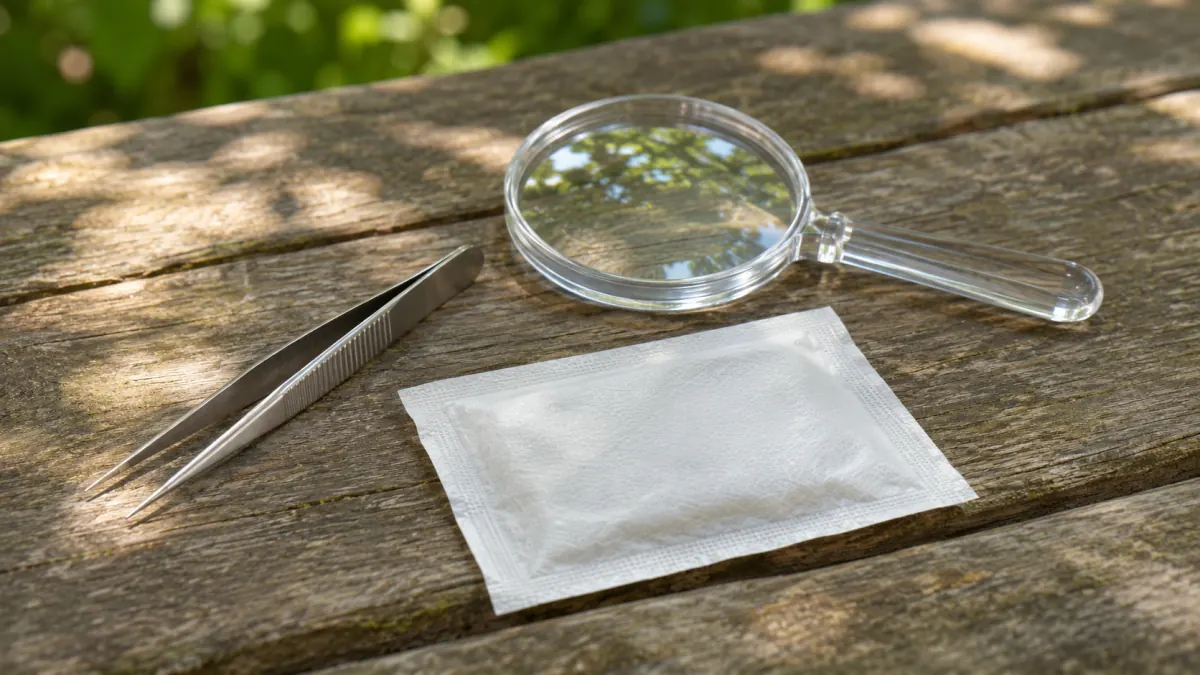
The weathered boards of a dock near Musselman’s Lake, a split cedar fence along a Gormley backyard, the picnic tables at Memorial Park after a long season of sun: some of the nicest parts of summer around Stouffville are made of old wood, and old wood bites back. A bare foot or an idle hand slides along a plank, there is a sharp sting, and suddenly someone is squinting at a dark sliver under the skin while a child wails and a parent hunts for tweezers.
Most splinters are minor and can be handled at home in a couple of minutes. Some, though, go deeper than they look, break apart when pulled, or are made of material that is easy to miss and quick to infect. And splinters are only one kind of foreign body: glass, metal shavings, thorns, fish hooks, and the beads, peas and tiny toys that children find room for in their noses and ears all come with their own rules. Here is how to sort the simple from the not-so-simple.
Removing a simple splinter at home
A splinter you can see, that sits shallowly and lies roughly parallel to the skin, is usually a good candidate for home removal.
What you need
- Good light and, ideally, a magnifying glass
- Fine-pointed tweezers
- A sewing needle (for splinters fully under the skin)
- Rubbing alcohol or an antiseptic wipe
- Soap, water and a clean bandage
Step by step
- Wash your hands and the area with soap and water.
- Clean the tweezers and needle with rubbing alcohol.
- Look at the angle. Note which direction the splinter went in. You will pull it out along that same line.
- If an end is sticking out, grasp it firmly with the tweezers as close to the skin as possible and pull out slowly along the entry angle.
- If it is just under the surface, use the needle to gently lift or break the thin layer of skin over one end, then grip that end with the tweezers. You should not need to dig.
- Check that it is all out. Wood can split; look for remaining fragments.
- Wash again, apply a thin layer of petroleum jelly if you like, and cover with a bandage.
Tricks that sometimes help
- Soaking the area in warm water for 10 to 15 minutes can soften the skin and make the end easier to reach.
- Tape works well for tiny, numerous slivers such as cactus spines or fibreglass. Press a piece of strong tape over the area and peel it off.
- Numbing with a wrapped ice cube for a minute before you start can make a child more cooperative.
What not to do
- Do not squeeze the area hard; this can break the splinter or push it deeper.
- Do not dig repeatedly with a needle. If you cannot get it after a couple of gentle tries, stop.
- Do not use a knife or blade.
When a splinter needs a clinician
Some splinters are better left to someone with proper light, sterile instruments and local anaesthetic. Book a visit if:
- It is deep, large, or broken off below the skin surface.
- It is under a fingernail or toenail. These are painful and easy to make worse.
- It is near the eye, or in a spot where nerves, tendons or joints sit close to the surface (the palm, the joints of the fingers, the sole of the foot).
- It is made of glass or metal and you cannot see the whole piece.
- The area is becoming infected: increasing redness, warmth, swelling, pus or red streaks.
- You have diabetes or poor circulation, particularly for anything in the feet.
- Your tetanus protection may be out of date.
At our clinic, removal is handled as a minor procedure. The area is cleaned and numbed, the opening is widened slightly if needed, and the object is lifted out under direct view. If there is any concern that the wound might become infected, the clinician will talk you through minor wound care and what to watch for.
Why wood is tricky
Wooden splinters are organic. They absorb moisture and carry bacteria and fungi from the outdoors, so a fragment left behind is more likely to cause infection or a lingering, tender bump. They also tend to be invisible on plain X-rays. If a clinician suspects a hidden wooden fragment, an ultrasound is often more useful. Glass and most metals, in contrast, frequently show up on X-ray. When imaging is needed, our team can arrange diagnostic imaging referrals.
Tetanus: the reason every puncture counts
Tetanus bacteria live in soil and can enter through small punctures, including splinters and thorn pricks. The infection is rare in Canada because of vaccination, but it is serious when it happens.
General guidance for adults:
| Type of wound | When a booster is usually recommended |
|---|---|
| Clean, minor wound | If your last tetanus shot was more than 10 years ago, or you are not sure |
| Dirty or deep wound (soil, rust, a puncture, an animal-related injury) | If your last shot was more than 5 years ago, or you are not sure |
| Never fully vaccinated | Vaccination series plus, in some cases, additional treatment |
If you cannot remember your last tetanus shot, assume you may be due and ask. Our adult vaccinations page explains which boosters adults typically need. For more about cuts and scrapes over the summer months, see our earlier article on summer cuts, burns and wound care.
Fish hooks and other outdoor hazards
Anyone fishing off a dock or a canoe in the Stouffville area eventually meets a hook from the wrong side. If a hook is embedded past the barb:
- Do not yank it straight back out; the barb will tear tissue.
- If it is in or near the eye, face, or a joint, leave it in place, protect it from being bumped, and seek care urgently.
- Otherwise, cut the fishing line, keep the area still and clean, and see a clinician, who can remove it with local anaesthetic and a proper technique.
Thorns from roses, raspberry canes and hawthorn can also leave fragments behind. Some plant material causes a delayed inflammatory reaction, so a spot that looked fine at first may become tender days later. That is worth having checked. Gardeners in Stouffville who prune roses or clear brambles along a back fence line should consider gloves with a thick palm; they prevent a surprising number of these visits.
Objects in children’s noses and ears
Small children explore with their whole bodies, and parents in Stouffville are no strangers to the moment a preschooler announces that a bead has gone “up there.” Beads, pebbles, small toy parts, food and pieces of crayon all end up in noses and ears with surprising regularity.
Nose
Signs a child has something in the nose include a one-sided, foul-smelling discharge, nosebleeds on one side, or a child who simply tells you. If you can see the object:
- Have the child blow their nose firmly while you gently block the other nostril, if they are old enough to do this.
- Do not try to grab a round object with tweezers or a cotton swab; you can push it deeper.
- If that does not work, bring them in for assessment.
Ear
Insects, beads and bits of tissue are common. For a live insect, an adult can tilt the head so the affected ear faces up and pour in a little warm (not hot) mineral or vegetable oil to stop the movement, unless there is any chance the eardrum is perforated or tubes are in place. Otherwise, do not put anything into the ear canal. A clinician can usually remove ear objects with the right instruments and light.
Emergencies: when it is not a clinic visit
Some foreign bodies are true emergencies. Go to the nearest emergency department, such as Markham Stouffville Hospital or Uxbridge Hospital, or call 911 for:
- A swallowed button battery or magnet, or a battery in the nose or ear. Button batteries can cause serious burns within hours, and multiple magnets can pinch the bowel. Do not wait for symptoms.
- Choking or breathing difficulty, including noisy breathing or drooling after a child may have put something in their mouth.
- Anything penetrating the eye, or a sharp object stuck in the eye. Do not remove it; cover the eye loosely and get help.
- Metal fragments in the eye from grinding, hammering or power tools, especially with pain or blurred vision.
- An object deeply impaled in the body. Leave it in place and stabilize it.
- Signs of a spreading infection with fever, or red streaks moving up a limb.
For anything you are unsure about after hours, Health811 (call 811) can help you decide where to go.
Will a splinter come out on its own?
Should I put antibiotic ointment on after removing a splinter?
Getting a stubborn splinter out at our clinic
If you have tried the tweezers twice and the sliver is still winning, stop and let us help. A splinter that is removed cleanly heals faster than one that has been chased around with a needle. You can book an appointment at our Main Street clinic in Stouffville or check the location page for directions and current hours, which may change.
This article is meant as general information and cannot replace an in-person assessment.